


Drawn Into the Dance
- Paul Coleman
- May 31
- 4 min read

At this morning's service I was challenged to think of the idea of the Trinity in a different way. Rather than trying to explain the Trinity we were instead encouraged to think about how we experience the Trinity. So here is my reflection drawing on this morning's sermon as well as some of my own reading and experience.
Like many preachers I have often felt compelled to try and explain the Trinity, often reaching for dodgy analogies or delving into church history and doctrine to explain how this belief came to be so central to church teaching.
But perhaps the Trinity is not first of all something we need to try to explain. Perhaps it is something we are drawn into.
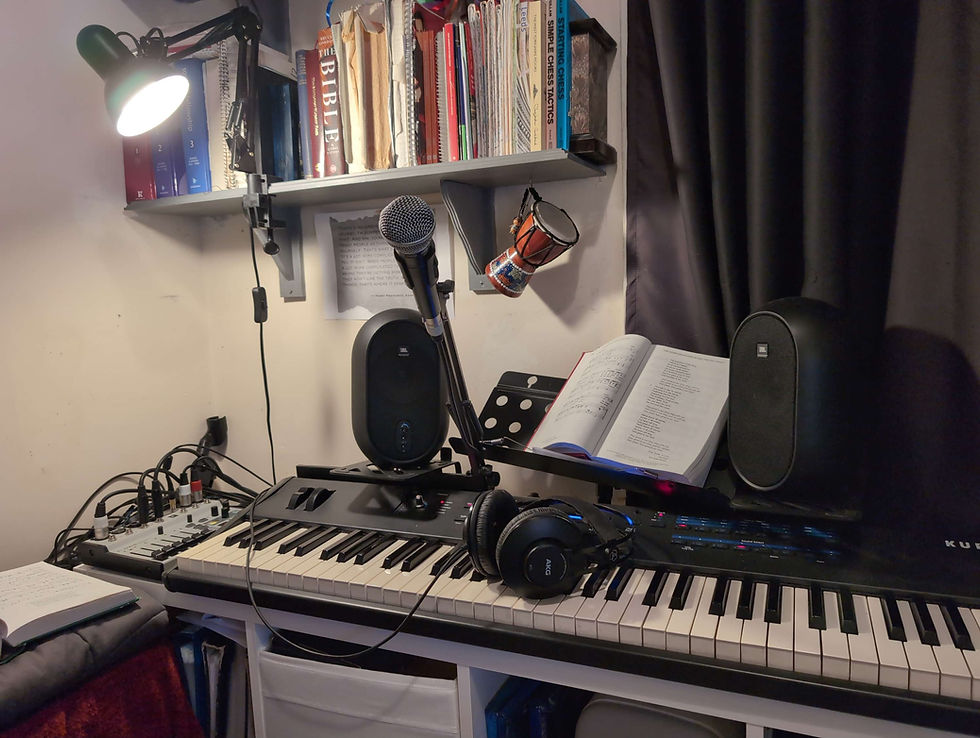
One of the songs that was mentioned this morning was Graham Kendrick’s Teach Me to Dance. It is a song that I personally love to play. However, I am possibly the least qualified person to talk about dancing. I cannot dance. I do not enjoy dancing. Unless we are counting dad dancing, and even then the point is that it is meant to be embarrassing.
“Teach me to dance to the beat of your heart” is not, for me, a confident statement from someone who knows the steps. It is a prayer from someone who does not. It is not “watch me dance beautifully for God.” It is “teach me.”
That feels much closer to faith as I actually experience it.
Faith is not simply having the right explanation of God. It is learning, often clumsily, to move in response to God. Sometimes that movement is joyful. Sometimes it is hesitant or awkward. But the point is not performance. The point is being drawn into the rhythm of God’s love.
That is where the song becomes, for me, a way of thinking about Trinity Sunday. It speaks of the heart of God, the power of the Spirit, the light of God’s presence, and a life being turned towards love, trust and hope. It is not a neat doctrinal explanation of the Trinity. But it does give us something of the experience of being drawn into the life of God.
This connects with a book I keep coming back to. Thomas Jay Oord’s idea of the uncontrolling love of God. Oord argues that God’s love does not coerce, dominate or override creation. God works through invitation and faithful presence rather than control. Dance seems to me a good image for that, precisely because a dance can be led, but it cannot truly be forced. If it is forced, it stops being dance and becomes domination.
Grace is not God grabbing hold of us and dragging us along. Grace is God meeting us, forgiving us, sustaining us, and making new movement possible. It teaches us the steps, but it does not erase our freedom.
It also impacts the way we understand church. If the Spirit creates fellowship, then fellowship cannot be based on coercion, fear, or forced conformity. The church is not called to control people into holiness. It is called to become a community where people can learn the rhythm of grace together.
That means making space for the awkward, the questioning, the neurodivergent, the disabled, the wounded, the excluded, and those who do not easily fit the expected pattern. If God’s love is uncontrolling, then the fellowship created by the Spirit should also resist domination.
Another hymn that sits alongside this for me is Be Thou My Vision. It is often sung in quite a stately, reflective way, and there is nothing wrong with that. But I tend to play and sing it more joyfully, in something closer to a Celtic style, often with a 6/8 rhythm.
That changes the feel of the hymn. It becomes less like standing still and more like a dance.
The words are still about vision, wisdom, presence, and God being the centre of everything. But with that rhythm underneath them, they begin to move. “Be Thou my vision” becomes not only a prayer about seeing rightly, but a prayer about moving differently. God is not only the one we look towards; God is the one by whose light we move.
Sung joyfully, the hymn also resists the idea that Christian surrender must always be heavy or passive. “Whatever befall” does not have to mean grim endurance. It can mean continuing to walk, sing, and perhaps even dance, badly, in my case, because God remains the light by which the road is travelled.
In Matthew 11:28 from The Message translation invites us to learn the “unforced rhythms of grace.”
I like that phrase because it does not sound like striving, pressure, or religious performance. It sounds like being taught another way to move, without God having to force us into step.
Together, Teach Me to Dance and Be Thou My Vision say something important about faith. One gives us the language of rhythm: God’s heart, God’s Spirit, God’s movement. The other gives us the language of orientation: God as vision, wisdom and light.
For me that is where the Trinity begins to make more sense, not as a puzzle to be solved, but as the life of God opened to us.
In Christ, we meet grace: the possibility of beginning again.
In God, we encounter love: not sentimental niceness, but the deep, self-giving love at the heart of all things.
In the Spirit, we are drawn into fellowship: shared life, belonging, and the slow work of becoming a people of peace.
That peace is not imposed order. It is not the silence created by power. It is the peace that grows when grace is received, love is trusted, and fellowship becomes real.
We are not invited merely to understand the dance from the outside; we are invited onto the floor. Even those of us who cannot dance.
And perhaps, by the Spirit, to learn again how to dance, however awkwardly, to the beat of God’s heart.


Comments